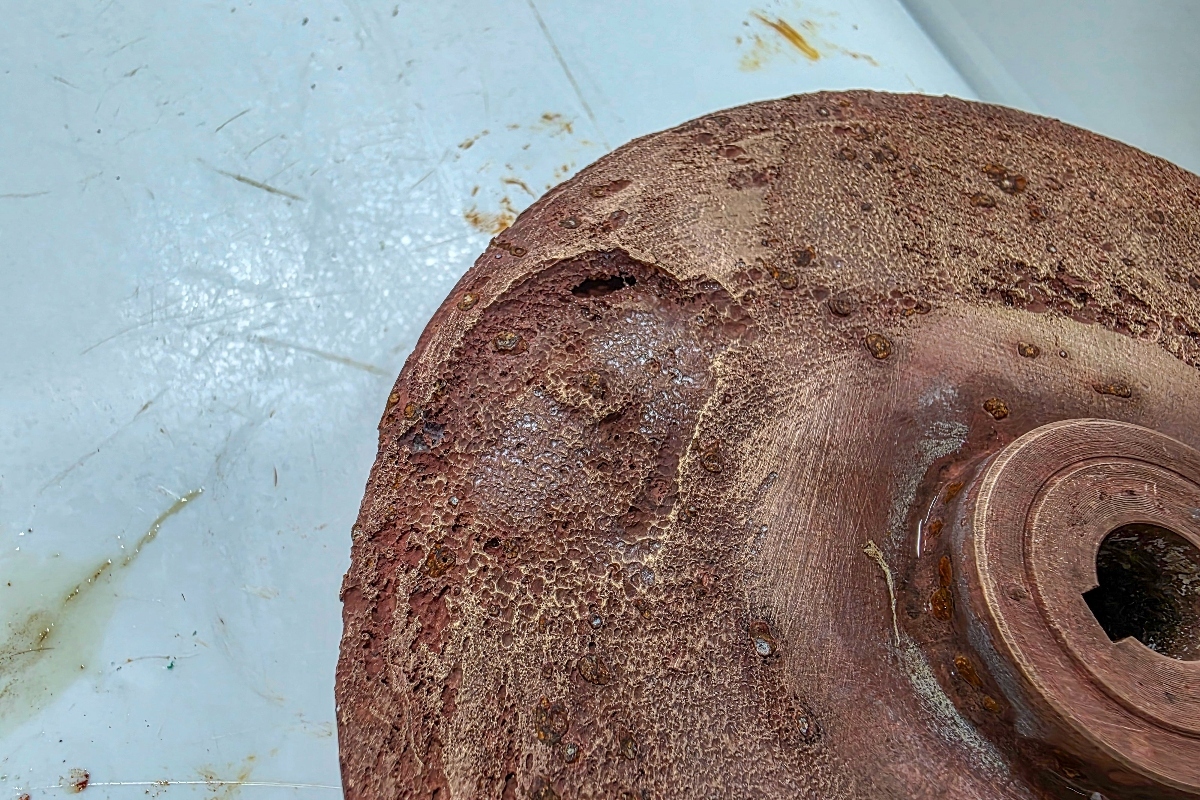
Pump erosion is a persistent and costly challenge in fluid handling systems across industries such as oil and gas, power generation, mining and process engineering. When abrasive particles or aggressive flow conditions interact with internal surfaces, material is gradually removed, compromising performance and reliability.
Left unchecked, erosion leads to declining efficiency, rising maintenance costs and, ultimately, premature component failure. Preventing it requires a clear understanding of the underlying mechanisms and a considered approach to design, materials and surface protection.
Understanding the causes of pump erosion
At its core, pump erosion is driven by the interaction between fluid dynamics and entrained particles. The two most common mechanisms in real-world systems are solid particle erosion and slurry erosion.
Solid particle erosion occurs when hard particles such as sand, scale or debris are carried within the fluid and strike internal surfaces at speed. Each impact removes a minute amount of material, but over time this repeated action leads to surface roughening and progressive wear. As surfaces degrade, turbulence increases, which in turn accelerates the erosion process.
Slurry erosion introduces an additional level of complexity. In these systems, solid particles are suspended within a liquid medium, often alongside corrosive elements. The fluid itself influences particle movement, creating unpredictable impact angles and sustained contact with surfaces. The result is a combined erosion-corrosion mechanism that is significantly more aggressive than either process alone.
Where erosion develops in pumps
Erosion concentrates in areas where flow is disrupted or accelerated. The most vulnerable regions typically include:
- Impellers, particularly leading edges and vane tips exposed to high-velocity flow
- Casing walls near volutes and cutwaters where turbulence is highest
- Wear rings and seals where tight clearances increase fluid velocity
Over time, localised erosion in these areas alters internal geometries, reducing hydraulic efficiency and increasing mechanical stress throughout the system.
The operational impact of erosion
The consequences of pump erosion extend far beyond visible surface damage. As internal geometries degrade, pumps must work harder to maintain performance, increasing energy consumption and operational costs. At the same time, imbalance and vibration can develop, placing additional strain on bearings and seals.
In many cases, the most significant impact is unplanned downtime. Components that fail prematurely disrupt operations, particularly in critical systems where reliability is essential. For industries handling abrasive or slurry-based fluids, erosion is often a primary driver of maintenance frequency and total lifecycle cost.
Preventing pump erosion - a holistic approach
There is no single solution to pump erosion. Effective prevention relies on a combination of design optimisation, appropriate material selection and advanced surface engineering.
Design and operational considerations
The first line of defence lies in how the pump is designed and operated. Reducing turbulence, controlling flow velocity and ensuring smooth flow paths all help to minimise the energy of particle impacts. Operating pumps within their intended design envelope is equally important, as off-design conditions often exacerbate erosion.
In practice, however, system constraints often limit how far design changes can go. This makes material and coating strategies essential.
Material selection
Selecting more erosion-resistant base materials can provide incremental improvements. Common approaches include:
- Hard alloys such as high-chrome irons or hardened steels for improved abrasion resistance
- Elastomers or polymers in lower temperature or less aggressive environments where flexibility is beneficial
- Ceramics for extreme hardness, although their brittleness can limit performance under impact
These materials can extend service life, but they are rarely sufficient on their own in high-wear or slurry-based applications.
The role of protective coatings
Surface coatings are often the most effective way to combat pump erosion because they directly protect the areas exposed to wear without requiring a complete redesign of the component. Different coating technologies offer varying levels of performance:
- Thermal spray coatings provide thick layers but are inherently porous and mechanically bonded, making them susceptible to cracking and delamination.
- Hard chrome plating delivers hardness and a smooth finish but contains microcracks that can accelerate erosion and corrosion.
- Physical vapour deposition (PVD) produces dense coatings, yet limited thickness and line-of-sight application restrict effectiveness in demanding or complex geometries.
In contrast, CVD tungsten carbide coatings form a dense, pore-free structure with a strong metallurgical bond to the substrate. This enables them to combine hardness with toughness, resisting both abrasive wear and repeated particle impact. Their ability to coat complex internal geometries uniformly is particularly advantageous in pump applications, where erosion often occurs in difficult-to-reach areas.
A proven solution for pump erosion
Pump environments expose components to a complex combination of abrasion, impact and corrosion, meaning that effective erosion prevention depends heavily on coating performance. Solutions must not only provide hardness, but also resist cracking, maintain strong adhesion and deliver consistent protection across complex geometries.
Hardide’s CVD tungsten carbide coating has been specifically developed to meet these demands. Its dense, pore-free structure and inherent toughness enable it to withstand the real-world conditions that cause conventional coatings to fail. The result is significantly extended component life, improved reliability and reduced maintenance, making it one of the most effective solutions available for preventing pump erosion.
Download our guide below to find out more about CVD’s capabilities to protect components against erosion.